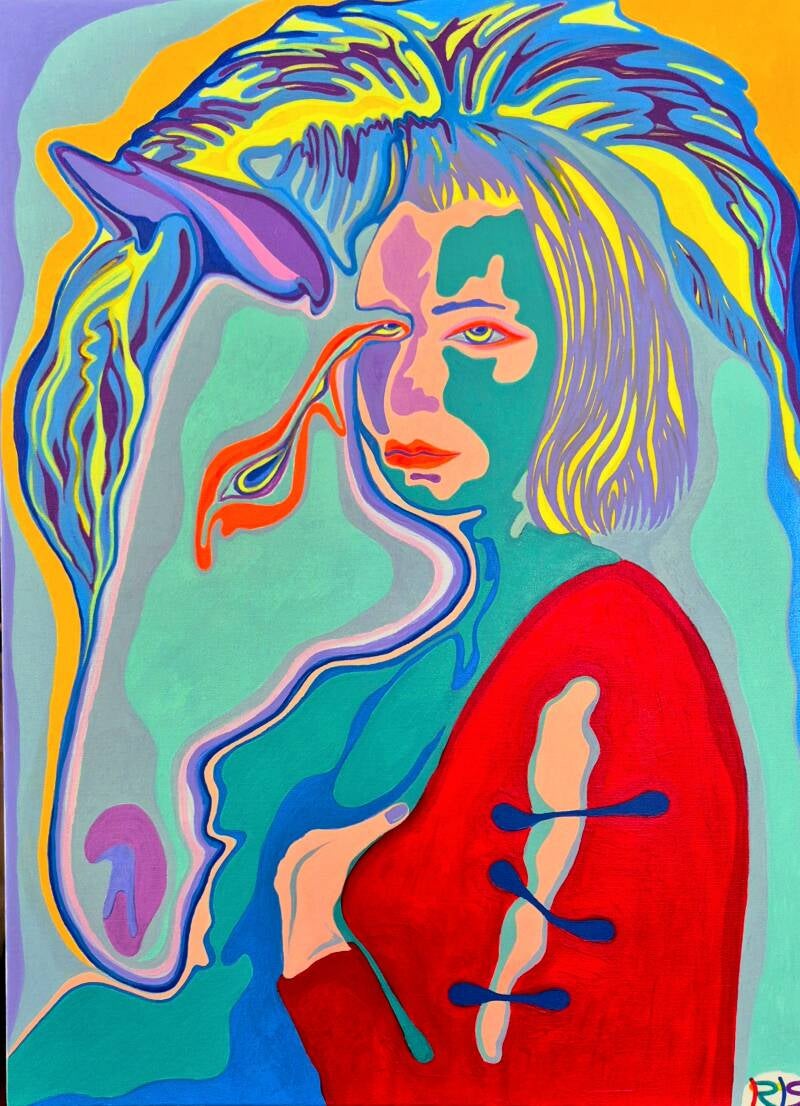
In Best Friend, Carmen Rieger sviluppa una riflessione complessa e stratificata sul rapporto tra essere umano e animale, trasformando la rappresentazione in un’esperienza di fusione identitaria e attraversamento percettivo. L’opera si costruisce attorno a una compenetrazione visiva tra il volto femminile e il cavallo, dove le due presenze non sono più distinguibili come entità separate, ma si fondono in un organismo unico, fluido, in costante ridefinizione.
La figura umana emerge come una superficie attraversata da campiture cromatiche vibranti e antinaturalistiche: verdi intensi, viola saturi, azzurri lattiginosi e gialli acidi non rispondono a una logica mimetica, ma si configurano come indicatori di una dimensione interiore. Il volto diventa così una mappa psichica, un territorio in cui identità, emozione e percezione si stratificano e si frammentano. In questo contesto, il colore assume un ruolo strutturale, non decorativo: costruisce il senso, suggerisce tensioni, apre a una lettura che è al tempo stesso emotiva e simbolica.
Il cavallo, figura centrale nella composizione, introduce un livello ulteriore di significato. Tradizionalmente associato alla libertà, alla forza vitale e all’energia istintiva, qui si configura come una presenza liminale, sospesa tra alterità e appartenenza. Non è semplicemente un “altro” rispetto all’umano, ma una sua estensione sensibile, una manifestazione di quella parte profonda e non razionale che abita l’identità. Il suo muso si avvicina fino a sfiorare l’occhio della figura umana, attivando un punto di contatto che assume un valore altamente simbolico.
È proprio in questo gesto che si concentra il nucleo semantico dell’opera: il contatto non è rappresentato come carezza o gesto affettivo convenzionale, ma come un vero e proprio attraversamento. Le linee fluide che uniscono le due figure sembrano veicolare un passaggio di energia, una comunicazione silenziosa che si colloca oltre il linguaggio. L’occhio — organo della visione e della coscienza — diventa soglia, punto di scambio tra due dimensioni dell’essere.
L’intera composizione è attraversata da forme morbide, ondulate, quasi liquide, che suggeriscono una realtà in continua metamorfosi. Nulla appare stabile o definitivo: identità e relazione si costruiscono come processi aperti, dinamici, instabili. In questo senso, l’opera può essere letta anche in chiave quasi archetipica o proto-sciamanica, dove il rapporto con l’animale non è gerarchico né simbolicamente distante, ma profondamente integrato nella costruzione del sé.
L’uso del colore, acceso e talvolta dissonante, contribuisce a creare una tensione visiva che non sfocia mai nel conflitto, ma rimane sospesa in un equilibrio delicato. Questa sospensione è uno degli elementi più significativi del lavoro: un tempo interiore dilatato, in cui lo spettatore è invitato a entrare, abbandonando una lettura puramente razionale per lasciarsi attraversare dall’immagine.
In Best Friend, Rieger propone così una ridefinizione radicale del concetto di amicizia. Non più relazione tra due entità distinte, ma spazio di risonanza e integrazione, in cui l’altro diventa parte costitutiva dell’identità. È un legame che non si limita alla prossimità, ma implica una trasformazione reciproca, un riconoscimento profondo che dissolve i confini tra sé e alterità.
L’opera si impone quindi come una riflessione contemporanea sulla natura delle relazioni e sull’identità come processo fluido, aperto e permeabile. In un tempo segnato da separazioni e definizioni rigide, Best Friend suggerisce invece la possibilità di una coesistenza intima e trasformativa, in cui umano e animale, razionale e istintivo, visibile e invisibile convivono in un’unica, potente immagine.
© 2026 Maria Di Stasio – Testo critico
Tutti i diritti riservati.
In Best Friend, Carmen Rieger develops a complex and layered reflection on the relationship between humans and animals, transforming representation into an experience of identity fusion and perceptual crossover. The work is constructed around a visual interpenetration between the female face and the horse, where the two presences are no longer distinguishable as separate entities, but merge into a single, fluid organism in constant redefinition.
The human figure emerges as a surface traversed by vibrant, anti-naturalistic chromatic fields: intense greens, saturated purples, milky blues, and acid yellows do not respond to a mimetic logic, but are configured as indicators of an interior dimension. The face thus becomes a psychic map, a territory in which identity, emotion, and perception are stratified and fragmented. In this context, color takes on a structural, not decorative, role: it constructs meaning, suggests tensions, and opens up a reading that is simultaneously emotional and symbolic.
The horse, the central figure in the composition, introduces a further level of meaning. Traditionally associated with freedom, vital force, and instinctive energy, here it appears as a liminal presence, suspended between otherness and belonging. It is not simply "other" than the human, but a sensitive extension of it, a manifestation of that profound and non-rational part that inhabits identity. Its muzzle approaches until it almost touches the eye of the human figure, activating a point of contact that takes on a highly symbolic value.
It is precisely in this gesture that the semantic core of the work is concentrated: the contact is not represented as a caress or a conventional affectionate gesture, but as a true crossing. The fluid lines uniting the two figures seem to convey a passage of energy, a silent communication that lies beyond language. The eye—the organ of vision and consciousness—becomes a threshold, a point of exchange between two dimensions of being.
The entire composition is traversed by soft, wavy, almost liquid forms, suggesting a reality in constant metamorphosis. Nothing appears stable or definitive: identity and relationships are constructed as open, dynamic, and unstable processes. In this sense, the work can also be read in an almost archetypal or proto-shamanic way, where the relationship with the animal is neither hierarchical nor symbolically distant, but deeply integrated into the construction of the self.
The use of color, bright and sometimes dissonant, helps create a visual tension that never leads to conflict, but remains suspended in a delicate balance. This suspension is one of the most significant elements of the work: an expanded interior time, into which the viewer is invited to enter, abandoning a purely rational interpretation and allowing themselves to be transfixed by the image.
In Best Friend, Rieger thus proposes a radical redefinition of the concept of friendship. No longer a relationship between two distinct entities, but a space of resonance and integration, in which the other becomes an integral part of identity. It is a bond that is not limited to proximity, but involves a mutual transformation, a profound recognition that dissolves the boundaries between self and otherness.
The work thus presents a contemporary reflection on the nature of relationships and on identity as a fluid, open, and permeable process. In an age marked by separations and rigid definitions, Best Friend suggests the possibility of an intimate and transformative coexistence, in which human and animal, rational and instinctive, visible and invisible coexist in a single, powerful image.
© 2026 Maria Di Stasio – Critical Text
All rights reserved.
Aggiungi commento
Commenti